
Hydroponic Odour Control
How to Control the Odours in your Growroom

Odour control is an important part of a hydroponics setup because strong plant, nutrient and growing-medium smells can quickly build up in an enclosed grow room or grow tent. Good odour management also improves air quality and helps maintain a cleaner, more controlled growing environment.
Why odour control matters in a hydroponics setup
1. Prevents strong smells from spreading
Plants can release noticeable aromas as they mature, while organic nutrients, stagnant water and growing media can also produce unpleasant odours. Without adequate ventilation and filtration, these smells can spread into adjoining rooms or outside the building.
2. Helps maintain good air quality
Odour is often an indication that airborne compounds are accumulating. Proper air exchange removes stale air and replaces it with fresh air, helping maintain a healthier environment around the plants.
3. Reduces smells caused by stagnant water
Hydroponic reservoirs should be kept clean and well oxygenated. Poorly maintained water can develop unpleasant smells, particularly when organic material accumulates or microbial activity becomes excessive.
4. Supports a cleaner growing environment
Regular cleaning of reservoirs, trays, pipes and growing equipment reduces the build-up of organic residues that can contribute to unwanted odours.
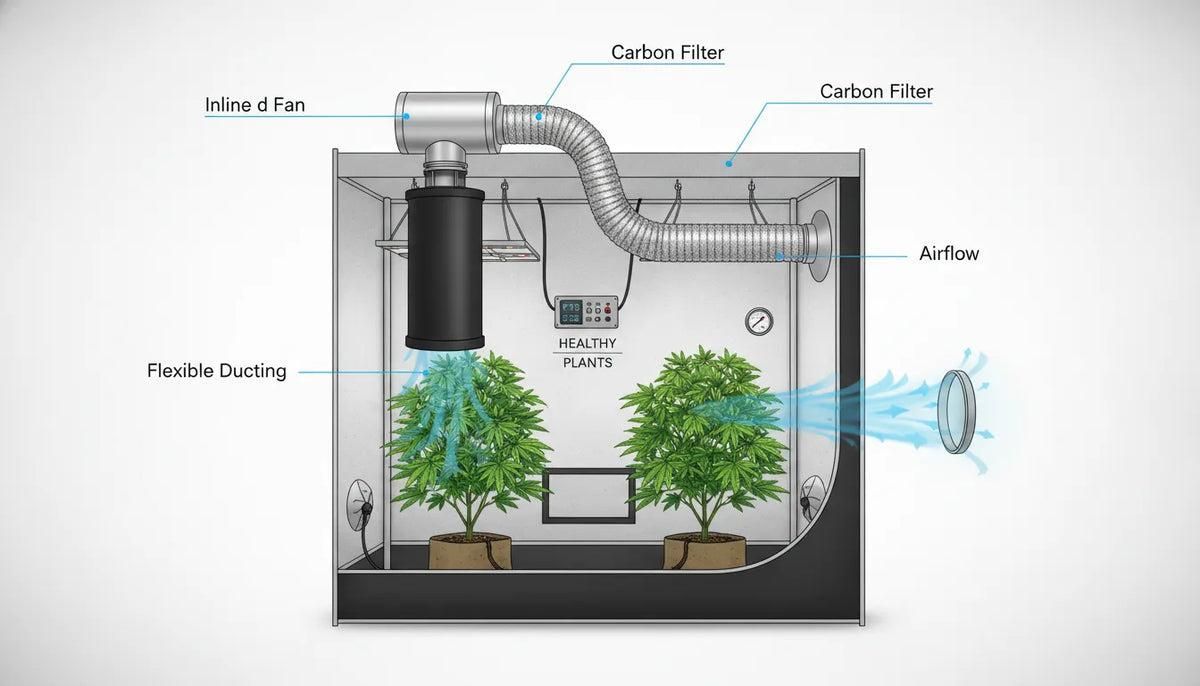
How to control odour effectively
1. Use an activated-carbon filter
An activated-carbon filter is one of the most effective ways of removing airborne odour compounds. It is normally installed on the extraction side of the ventilation system.
A typical arrangement is:
Grow room → carbon filter → inline extraction fan → ducting → exhaust
The fan draws air through the carbon, where many odorous compounds are adsorbed before the air is exhausted.
2. Make sure the extraction system is appropriately sized
The carbon filter and inline fan need to work together. An undersized system may not exchange enough air, while an excessively restricted filter can reduce airflow.
For a grow tent, position the filter high in the space because warm air naturally rises. Connect it securely to the extraction fan with suitable ducting.
3. Maintain good air circulation
Circulation fans should move air around the growing area rather than simply blowing continuously at the plants. Good circulation helps prevent stagnant pockets of humid air and distributes temperature and humidity more evenly.
4. Keep the reservoir and equipment clean
Regularly inspect and clean:
- Nutrient reservoirs
- Pumps and air stones
- Pipes and irrigation lines
- Drip trays
- Growing media
- Filters and pre-filters
Remove dead or decaying plant material promptly.
5. Avoid letting organic residues accumulate
Organic nutrients and additives can leave residues that contribute to odour if equipment isn't maintained properly. Follow the manufacturer's mixing and cleaning recommendations rather than continually adding products to compensate for a problem.
6. Monitor the root environment
Unusual smells coming from the reservoir or root zone can indicate that something needs attention. Healthy hydroponic systems should not normally produce a strong rotten or sewage-like smell. Check water temperature, oxygenation, cleanliness and the condition of the roots if this occurs.
A simple odour-control system
For many indoor hydroponic setups, a practical arrangement is:
Fresh-air intake → grow area → circulation fans → carbon filter → extraction fan → exhaust
This creates controlled airflow through the growing space while filtering the extracted air.
The key is to treat odour control as part of the overall ventilation and hygiene system, rather than simply masking smells with fragrances. A properly maintained carbon filter, adequate extraction, good air circulation and clean hydroponic equipment will provide much more effective long-term odour management.