
Enhancing Flower Potential in Hydroponic Grow Rooms
The Importance of Phosphorus, Potassium, and Natural Nutrient Uptake
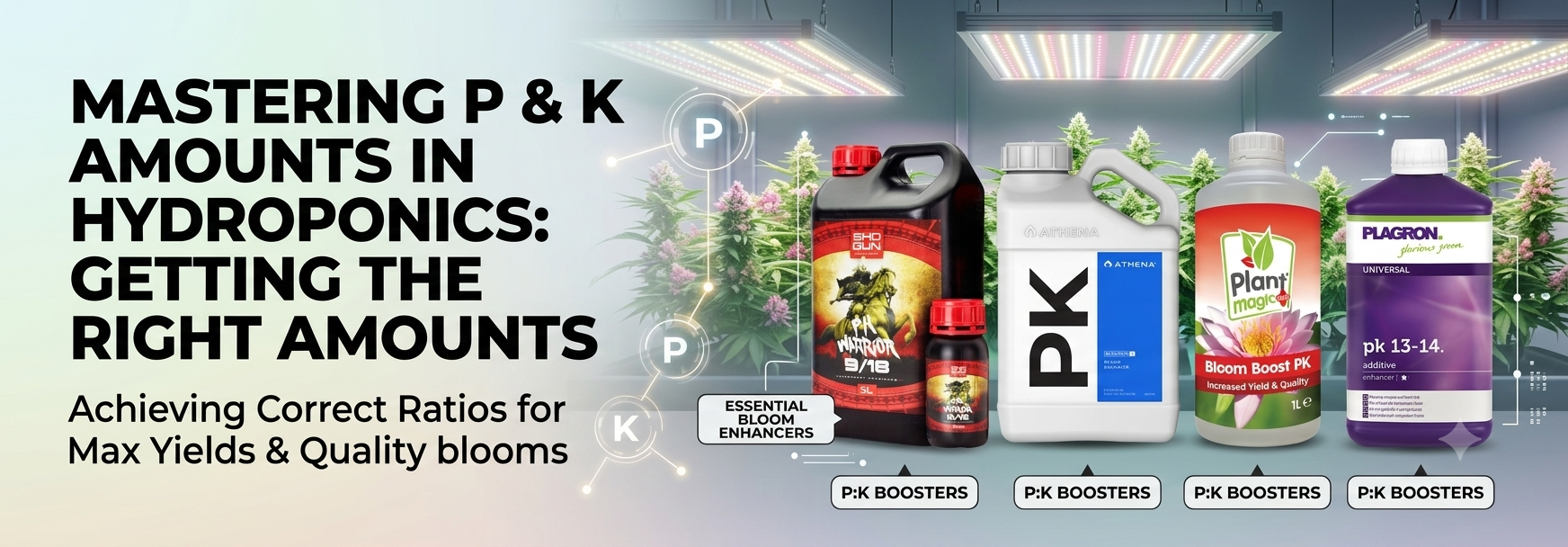
Producing large, dense, resin-rich flowers is the goal of every hydroponic grower. While environmental factors such as lighting, temperature, humidity, and CO₂ all contribute to success, the nutrient programme you choose has one of the biggest impacts on flower development.
During the flowering stage, plants require a carefully balanced supply of nutrients that supports bud formation, flower expansion, resin production, and overall plant health. Understanding how phosphorus (P), potassium (K), and natural nutrient enhancers work together can help maximise every harvest.
Why Flowering Nutrition Matters
As plants transition from vegetative growth into flowering, their nutritional demands change significantly.
Instead of focusing on producing stems and leaves, the plant redirects its energy into developing flowers. This process requires large amounts of energy and efficient nutrient transport throughout the plant.
Providing the correct flowering nutrients ensures plants can:
- Produce larger flowers
- Increase flower density
- Improve essential oil and terpene production
- Enhance resin development
- Maximise overall yield
- Maintain healthy foliage throughout bloom
The Importance of Phosphorus (P)
Phosphorus plays a vital role during flowering because it drives many of the plant's energy-transfer processes.
It is responsible for:
- Root development
- Flower initiation
- Cell division
- Energy storage (ATP production)
- DNA and RNA synthesis
When phosphorus is readily available, plants can efficiently build new flower sites while supporting rapid bud expansion.
A deficiency during bloom often results in:
- Slow flower development
- Small buds
- Delayed maturity
- Reduced final yields
Why Potassium (K) Is Just as Important
Potassium is often referred to as the "quality nutrient" because it influences nearly every aspect of flower production.
Potassium helps regulate:
- Water movement throughout the plant
- Sugar transport
- Enzyme activation
- Protein synthesis
- Cell strength
- Stress resistance
High potassium availability allows plants to move carbohydrates produced during photosynthesis directly into developing flowers, resulting in larger, denser blooms.
Adequate potassium also improves:
- Flower weight
- Bud density
- Aroma production
- Plant resilience
- Overall harvest quality
Getting the Phosphorus-to-Potassium Ratio Right
Simply increasing phosphorus isn't enough.
The relationship between phosphorus and potassium is what determines how efficiently a flowering plant develops.
A well-balanced P:K ratio allows the plant to:
- Build strong flower structures
- Transport sugars efficiently
- Support rapid cell expansion
- Increase flower density
- Reduce nutrient stress
Too much phosphorus without sufficient potassium can limit nutrient movement and reduce flower quality.
Likewise, excessive potassium can interfere with the uptake of important secondary nutrients if not balanced correctly.
Premium bloom nutrients are formulated to provide the correct phosphorus and potassium ratio throughout flowering, helping plants maintain vigorous flower production from the first week of bloom through to harvest.
Natural Ingredients That Maximise Nutrient Uptake
Modern hydroponic nutrients often include natural bioactive ingredients that improve nutrient uptake rather than simply increasing nutrient strength.
These ingredients help plants utilise every feed more efficiently.
Common natural nutrient enhancers include:
Fulvic Acids
Fulvic acids act as natural nutrient transporters.
They help carry minerals into plant cells, improving nutrient availability while increasing uptake efficiency.
Benefits include:
- Improved micronutrient absorption
- Faster nutrient movement
- Enhanced root activity
- Better overall plant vigour
Humic Acids
Humic substances encourage stronger root development while improving nutrient exchange around the root zone.
This results in:
- Increased root mass
- Better nutrient buffering
- Improved plant health
- Enhanced nutrient availability
Natural Plant Extracts
Seaweed extracts, plant-derived biostimulants, and botanical compounds naturally stimulate plant metabolism.
These ingredients may encourage:
- Stronger root systems
- Increased chlorophyll production
- Improved stress resistance
- Greater flower development
Amino Acids
Naturally derived amino acids reduce the amount of energy plants spend producing proteins.
This allows more energy to be directed towards flower production and resin development.
Benefits include:
- Faster recovery from stress
- Increased metabolic activity
- Improved nutrient utilisation
- Better flowering performance
Nutrient Uptake Is More Important Than Nutrient Strength
Many growers believe increasing EC automatically increases yields.
In reality, plants can only use nutrients that they successfully absorb.
A balanced feeding programme containing natural uptake enhancers often produces better results than simply increasing nutrient concentration.
Efficient nutrient utilisation can lead to:
- Larger flowers
- Better nutrient efficiency
- Reduced nutrient waste
- Healthier root systems
- More consistent harvests
Creating the Ideal Flowering Environment
Even the best bloom nutrients perform best when paired with an optimised grow room.
For maximum flower potential, maintain:
- Stable temperatures between 20–28°C during lights-on
- Appropriate humidity that gradually decreases throughout flowering
- Strong but controlled airflow
- Adequate light intensity
- Correct pH for nutrient availability
- Consistent irrigation schedules
- Healthy oxygen levels around the root zone
When environmental conditions and nutrition work together, plants can fully express their genetic potential.
Final Thoughts
Achieving exceptional flowers in a hydroponic grow room is about more than simply feeding more nutrients. The correct balance of phosphorus and potassium provides the foundation for vigorous flower development, while natural ingredients such as fulvic acids, humic acids, amino acids, and plant extracts help maximise nutrient uptake and utilisation.
By combining a well-formulated bloom nutrient with an optimised growing environment, growers can encourage larger, denser, higher-quality flowers while improving nutrient efficiency and overall plant health. The result is a healthier crop capable of delivering outstanding yields and premium-quality harvests.